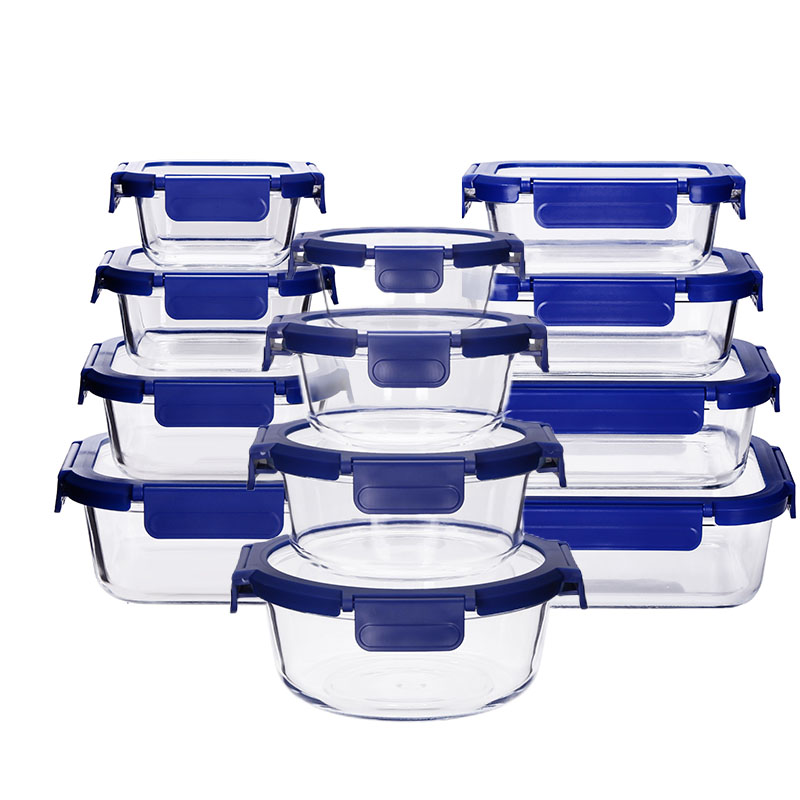
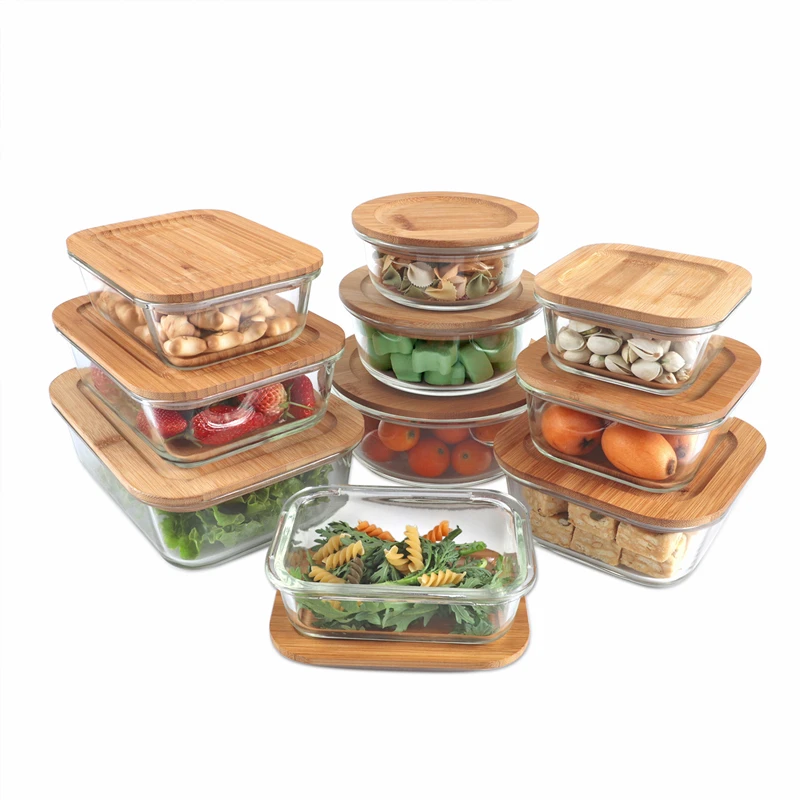
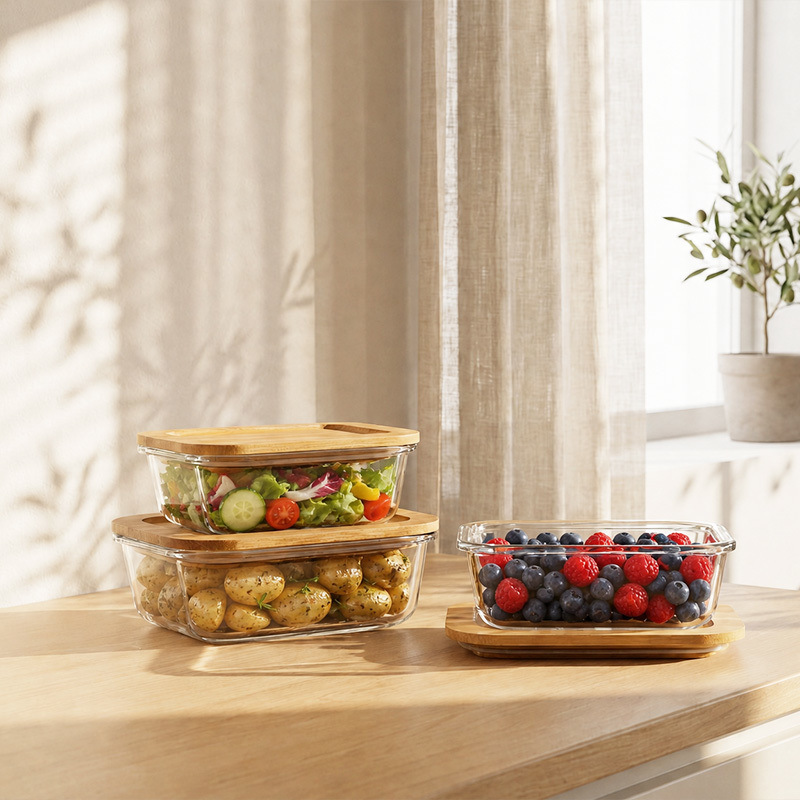
Lidded glass food containers
Food-storage directions include everyday rectangular, round and other selected forms. Define the glass body and the lid as separate components, with the actual capacity, outside envelope, sealing arrangement and use instructions. A container’s glass construction does not establish that every attached lid or accessory can be heated with it.
Enquire about this range ↗Stackable, divided and lunch-box directions
Stackable sets, divided containers, mini sizes and lunch-oriented formats support different storage programmes. Confirm whether the glass nests when empty, stacks with the lid fitted or has fixed internal dividers. Specify the actual included containers and accessories; a photographed assortment is not an automatic set definition.
Enquire about this range ↗Bamboo, wood, glass and silicone lid choices
Selected containers use bamboo, wood, tempered-glass, silicone or metal lid directions, with combinations of latches and seals. Compare lid construction, cleaning access and replacement parts on the selected sample. Natural-looking lids do not establish antibacterial performance, and a silicone seal does not by itself establish a validated leak test.
Enquire about this range ↗Vacuum storage systems
Vacuum food-storage and pantry-jar directions use defined closures and sealing components. Specify whether the selected system uses a button, separate pump or other mechanism. Agree the compatible parts and retention test rather than promising a fixed extension of food life or treating a vacuum closure as a substitute for appropriate food storage.
Enquire about this range ↗Glass pantry jars and canisters
Canister directions include glass, wood, bamboo, cork and stainless-lid styles alongside vacuum options. Match capacity and mouth size to the intended contents, then confirm seals, handling and label space. Nominal capacities and outside heights should be kept on the article specification, with safe packing agreed for each size.
Enquire about this range ↗Baking dishes and covered bakeware
Rectangular, square, round and oval baking directions include covered formats and selected silicone-handling options. Define the glass body, handles, lid, seal and vent. Obtain instructions for the complete selected product, including whether accessories must be removed; general heat-resistant glass wording does not establish a universal operating temperature or thermal-shock limit.
Enquire about this range ↗Casseroles and transparent cooking vessels
Covered casserole and other glass cooking-vessel directions extend the kitchen range. Specify body and lid geometry, capacity, handle clearance and the actual heating method. Oven, hob, microwave and induction suitability are separate questions requiring confirmation; none is implied merely by the transparent appearance or the word casserole.
Enquire about this range ↗Mixing, salad and food-preparation bowls
Bowl directions include European-style, Japanese-style and lidded formats, as well as a combined grating, mixing and storage reference. Compare the rim, grip, lid and accessory fit. Each removable component needs its own material and care instruction, particularly where metal graters and plastic frames accompany a glass bowl.
Enquire about this range ↗Measuring cups and handled jugs
Glass measuring directions include a spout and handled formats across selected capacities. Define graduation units, scale positions, legibility and any required accuracy checks. A printed volume scale should not be described as calibrated laboratory equipment without a defined method and supporting evidence.
Enquire about this range ↗Cups, drinking ware and amber glass
Drinking directions include handled cups, double-wall formats and other glass cup styles, alongside amber-toned tableware. Specify volume, rim, wall construction, decorative process and any lid. A coloured or double-wall appearance does not establish a particular composition, insulation duration or resistance to impact.
Enquire about this range ↗Appliance and cookware glass components
Microwave turntables, glass steamers, cookware lids and blender-cup directions can be discussed against the intended appliance drawing. Specify dimensions, centre features, rim, engagement points and assembly tolerances. Compatibility must be checked with the actual appliance; similar size or appearance is insufficient to claim a universal replacement fit.
Enquire about this range ↗Stainless storage alternatives
A separate storage direction uses 304 stainless steel with a silicone sealing arrangement. Treat this as a distinct material programme with its own construction and care instructions. Do not transfer microwave-use wording from glass products to stainless containers, or assume that every lid uses the same material as the body.
Enquire about this range ↗Pharmaceutical tubular and moulded bottles
Packaging directions include tubular vials and moulded injection or infusion bottles, with selected colour, shape and coating variations. Define the material class, dimensions, neck finish, closure and supply condition for the application. Pharmaceutical suitability depends on the approved specification and qualification of the actual packaging system.
Enquire about this range ↗Ampoules and specialised shapes
Ampoule directions include B, C, D and selected special shapes with marking or opening-system options. Provide the intended fill, glass class, drawing and break-force requirements. Printing, rings, dots and identification marks can be discussed for the chosen design, with product-specific validation before commercial use.
Enquire about this range ↗Cartridges and prefillable syringe directions
Borosilicate cartridge and prefillable syringe directions require a separate technical enquiry. Selected cartridge options include coated, ready-to-use and custom dual-chamber directions. Confirm container dimensions, treatment, closure components and compatibility with the intended system; the catalogue does not establish suitability for every medicine or injection device.
Enquire about this range ↗Ready-to-use and treated packaging
Selected ready-to-use, coated or siliconised pharmaceutical formats can be discussed against the required filling process. The exact cleaning, sterilisation or depyrogenation state, packaging configuration and release evidence must be agreed. A conventional glass vial should not be presented as sterile merely because an RTU format exists in the range.
Enquire about this range ↗Pharmaceutical tubing and other bottle directions
Pharmaceutical glass tubing and separately listed oral-liquid, health-product and nasal-spray bottle directions broaden the packaging enquiry. Specify the actual material class, body and neck dimensions, closure and treatment. A tubing or bottle category is a starting point for technical selection, rather than blanket approval for a formulation.
Enquire about this range ↗Optical and lighting-glass enquiries
Optoelectronic and optical directions include glass for lighting or lens-related projects. Provide the intended component drawing, material, optical requirements and operating environment for feasibility review. Current delivery scope and performance need confirmation for the particular project; no universal lens, lamp-module or automotive qualification is implied.
Enquire about this range ↗