Industrial paint & solid-paint markers
Compare solvent paint, oil paint and solid-paint constructions around the work surface and operating conditions. Choose body, nib and colours, then confirm adhesion and required resistance through a sample and relevant evidence.
Enquire about this range ↗Permanent & narrow-access markers
Select general permanent, refillable, dual-tip or long-nib directions for labelling and recessed work. Specify the surface and access geometry; a long exposed nib alone does not guarantee reach into every opening.
Enquire about this range ↗Empty barrels & marker components
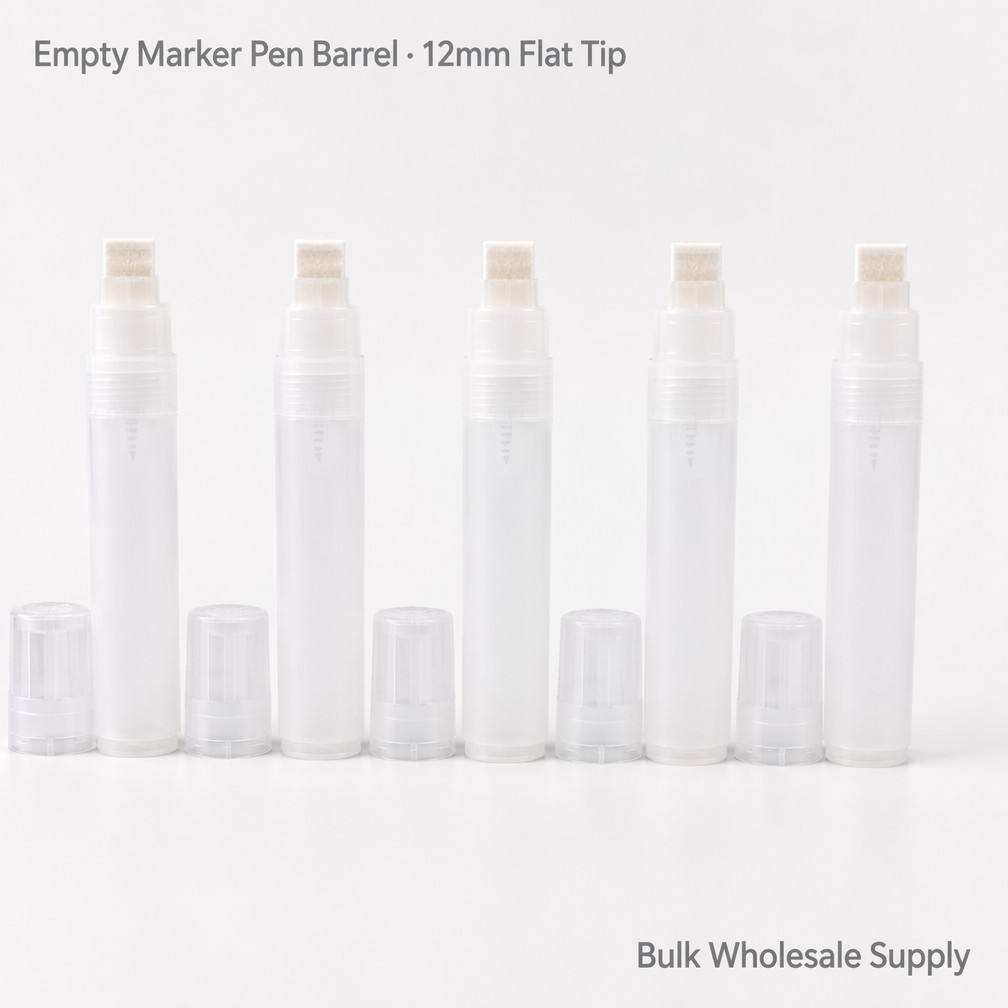
Develop a filling project around empty valve bodies, nibs and component requirements. Agree formulation compatibility, seals, filling equipment and decoration before treating the selected body as a finished private-label marker.
Enquire about this range ↗Ink refills
Separate permanent, whiteboard and poster-marker refills are product directions. Match the formula to the receiving model and define bottle volume, fill instructions, labels and packing; refill inks are not automatically interchangeable.
Enquire about this range ↗Whiteboard, greenboard & liquid chalk
Explore standard, liquid-ink, refillable and dual-colour board formats, alongside liquid-chalk and LED-display directions. Identify the actual board coating and erasing method, then compare visibility and removal on that surface.
Enquire about this range ↗Acrylic & colour-art markers
Brush-tip acrylic, colour markers and twin-nib directions support drawing and craft ranges. Define substrate, palette and intended coverage, and use real samples to distinguish paper behaviour from performance on coated or hard surfaces.
Enquire about this range ↗Fineliners, calligraphy & drawing
Build a precise-writing or lettering assortment around the actual point, brush or line required. Confirm paper interaction and the selected colour, with a sample defining line appearance and any resistance claim.
Enquire about this range ↗Glitter, metallic, chrome & outline effects
Compare decorative finish directions for cards, crafts and display work. Choose the intended effect and substrate, then assess coverage, drying and adhesion rather than assuming metallic, chrome and outline inks behave alike.
Enquire about this range ↗Textile drawing & sublimation
Separate water-removable textile drawing from heat-transfer projects. Define fabric or coated substrate, the intended permanence and processing equipment, then approve the actual removal or transfer result before developing packaging instructions.
Enquire about this range ↗Crayons, finger paint & colour play
Crayon and finger-paint directions broaden creative assortments beyond liquid markers. Establish the intended age, use context, colour allocation and relevant testing before choosing pack contents or making suitability claims.
Enquire about this range ↗Highlighters & everyday writing
Explore mini, dual-tip, liquid-ink and erasable highlighter directions, with selected roller and gel-writing products. Specify ink colours and paper, then check visibility, drying and any erasing behaviour on samples.
Enquire about this range ↗POP, poster, OHP & disc marking
Broad poster lettering, transparency and disc-marking directions serve different surfaces. Define line width, ink and material, with sample results supporting the intended advertising, presentation or labelling task.
Enquire about this range ↗Wood, grout & cleaning tools
Touch-up, grout, cleaning and sticker-removal directions address specific maintenance tasks. Identify the original material and coating, intended colour and acceptable removal process, then test compatibility on an inconspicuous area.
Enquire about this range ↗Glue pens & supporting accessories
Glue-pen and pencil-sharpener directions can support a stationery assortment alongside writing tools. Confirm the exact adhesive task or pencil diameter, physical configuration and pack contents before adding them to the purchasing brief.
Enquire about this range ↗