Standard and heavy-duty nylon ties
Select standard or wider heavy-duty ties by length, strap width, usable bundle diameter and the required loop-strength reference. PA66 is a material direction in the range, with different colours and special-grade enquiries. Confirm the exact polymer, conditioning and application environment. A black tie is not automatically a verified outdoor or UV-stabilized grade.
Enquire about this range ↗Stainless-steel ball-lock ties
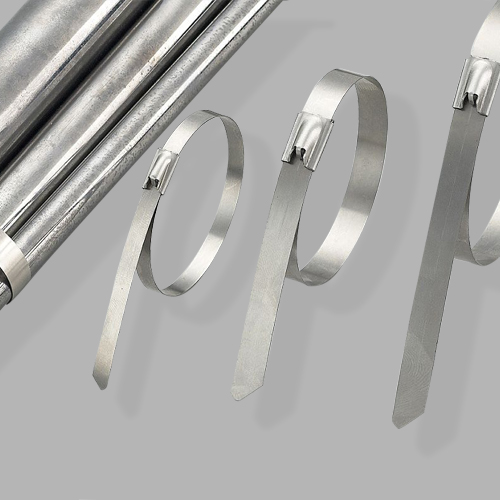
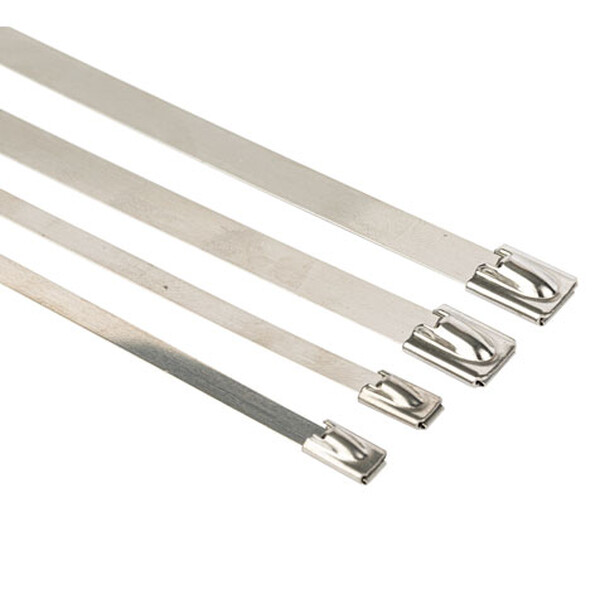
Metal ball-lock ties provide a separate construction direction. A catalogue family identifies 316 stainless steel; obtain material evidence for the actual order, together with edge condition, locking and installation-tool requirements. Match the route and environment, and evaluate contact with cable jackets. Do not treat tie strength as a rated lifting or restraint-system capacity.
Enquire about this range ↗Releasable and reusable bundling
Releasable-pawl ties, beaded ties, slotted interlinking straps and other reusable fastening directions support bundles requiring reopening. State access space, bundle material and the expected service operation. Evaluate the release mechanism and repeated-use conditions on the selected sample rather than promising unlimited reuse.
Enquire about this range ↗Low-profile, double-lock and parallel bundling
Reduced-head, double-lock, double-loop and parallel-locking directions address different routing and locking requirements. Compare head height, strap path, loop separation and tail presentation. Double-loop products keep two bundles separately routed; their two loop references should not be combined into a single bundle rating.
Enquire about this range ↗Marker ties and cable identification
Marker-tie directions combine a fastening loop with a flat identification area. Define the label dimensions, writing, printing or stamping method, colour and readability requirements. Confirm label adhesion and durability under the intended conditions. A larger marker area does not establish compatibility with every marking system.
Enquire about this range ↗Panel, push-mount and automotive fixings
Mounting ties, push fixings, fir-tree formats, separate-head arrangements and through-hole/rivet-style automotive straps provide different attachment directions. Submit hole size, panel thickness, fastener, bundle route and access constraints. Select the actual fixture and validate its retention for the application; an automotive catalogue direction does not establish vehicle-specific approval.
Enquire about this range ↗Edge clips and specialist tie profiles
Edge-clip fastening, twist-and-cut ties, positive-stop ties and other specialist profiles address different assembly needs. Metal/X-ray-detectable tie directions are also present in the catalogue. Specify the required function, panel/edge geometry and any detection or process-validation requirement. Detectability or a particular use case requires evidence for the exact material and system.
Enquire about this range ↗Adhesive and mechanical cable-tie mounts
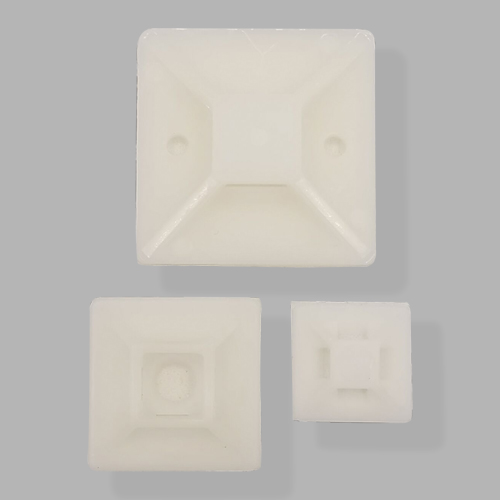
Self-adhesive bases, saddle mounts and other mounting holders offer different ways to position a bundle. Acrylic adhesive is described for one mount direction, including low-surface-energy substrate enquiries. Provide the substrate, cleaning process, temperature, load and dwell conditions. Agree an application test instead of assuming adhesive performance on every painted or plastic surface.
Enquire about this range ↗Nail clips, clamps and cable holders
Nail-in cable clips, round clips, P-type clips, releasable clamps, single-hinged clips, locking clips and strap-bracket arrangements support different installation styles. Match cable diameter, supporting surface and fixing method. Nail material, screw dimensions, adhesive base and any repeated opening need confirmation for the selected design.
Enquire about this range ↗Cable glands and entry fittings
Nylon gland directions include metric and other size references. Select by thread, cable outside diameter, panel hole, thread length and sealing arrangement. Request the complete drawing, locknut and insert details. A dimensional catalogue entry does not establish an ingress-protection rating, explosion protection or approval for a particular enclosure.
Enquire about this range ↗Spiral wrap, corrugated protection and trunking
Spiral wrapping bands, corrugated plastic pipe and PVC wiring-trunking directions support cable organization and routing. Define cable diameter, branching, bend radius, access and mounting. Confirm polymer, dimensions, wall or slot geometry and any environmental or flame requirements. Different protective products should not share one material or performance claim.
Enquire about this range ↗Heat-shrink tubing
Tubing references provide before/after dimensional pairs across different sizes. Specify the supplied and recovered diameter, recovered wall, cut length, material and heating conditions needed for the application. Ask for actual electrical and environmental data. Oil, chemical, high-temperature or adhesive-sealing performance should be supported by the selected product’s technical evidence.
Enquire about this range ↗Ring, spade and locking-spade terminals
Bare and insulated terminal directions include ring, spade and locking-spade constructions. Select conductor cross-section, stud or blade geometry, barrel, material, plating and insulation. Confirm the crimp tooling and installation process for the actual terminal rather than using a general current claim as the sole selection criterion.
Enquire about this range ↗Butt joints and disconnect terminals
Fully insulated and long insulated butt-joint directions, hooded joints and male/female disconnects support different connection and service requirements. Specify conductor range, mating geometry, insulation and intended operating conditions. Request the correct crimp method, pull-test criteria and mating compatibility for each connection.
Enquire about this range ↗Heat-shrink insulated terminals
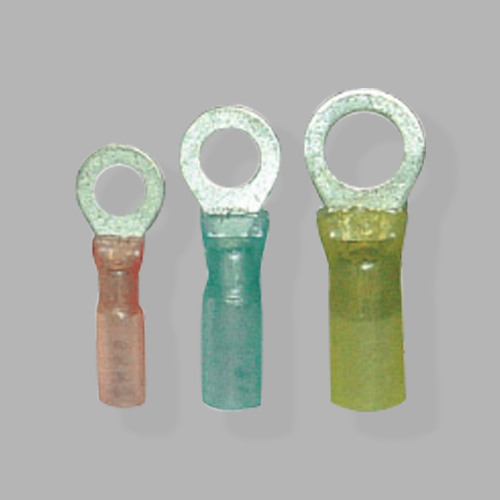
Ring, spade and butt-connector directions combine a copper terminal with heat-shrink insulation. Define conductor size, stud/blade dimensions, recovery requirements and tooling. Confirm whether an adhesive lining is present and which sealing or environmental claims are supported. Colour coding alone does not establish a conductor range or approval.
Enquire about this range ↗Tubular copper lugs and wire-end ferrules
Copper connecting lugs, bell-mouth tubular lugs and insulated cord-end terminal directions support larger conductors and panel wiring. Provide conductor construction, cross-section, stud, barrel dimensions and tool/die requirements. Obtain material and plating information and any required connection-test evidence. Confirm whether a lug or ferrule is suitable for the specified conductor class.
Enquire about this range ↗Terminal blocks and wire connectors
Block directions include H, U/W and V/F forms with different insulating-material directions. Screw-on spring wire connectors and closed-end crimp connectors provide other joining methods. State the wire number, conductor sizes, voltage, current, mounting and connection process. A block or connector shape does not establish compatibility with every wire combination.
Enquire about this range ↗Anchors, PCB supports and installation parts
Plastic anchors and PCB-support directions broaden the installation assortment. Specify the base material, hole, fastener, board thickness, standoff and clearance. Custom component enquiries need drawings and a validation plan. Supporting a cable or board in a catalogue illustration does not define structural or electrical clearances for a finished system.
Enquire about this range ↗Bundling tools and cable organizers
Cable-tie tension tools, one-touch tie-tool directions and circular cable organizers can be included alongside consumables. Match the tie material, width and required tension or cutoff. Define the assembly method, tool access and spare-part needs. A tool should be evaluated with the selected tie before specifying installation consistency.
Enquire about this range ↗Retail assortments and combination packs
Mixed-size or mixed-colour ties and wiring accessories can be developed as bag, tube, container or other retail-kit enquiries. Agree every included item, quantity, colour, pack format, insert and barcode. A catalogue pack example is a starting point; final contents, minimum quantities and packaging feasibility belong in the quotation.
Enquire about this range ↗Custom moulded component development
Custom injection-moulded wiring and installation parts can be discussed from drawings or samples. Define dimensions, tolerances, material, finish, function and acceptance criteria. Agree design review, tooling ownership, prototype approval, testing and changes before a production commitment. Manufacturing history or equipment counts should not be substituted for a product-specific development plan.
Enquire about this range ↗