Miniature circuit breakers
Build modular protection assortments around rated current, poles, trip characteristic, supply and verified breaking capacity. References cover different ratings and form factors, including compact neutral-pole arrangements. Match busbars, conductor capacity and mounting before treating devices as interchangeable. The short-circuit rating and standard must be stated with the selected version.
Enquire about this range ↗Residual-current protection
RCCB directions provide residual-current switching without integral overcurrent protection; RCBO directions combine residual-current and overcurrent functions. Specify the sensed waveform type, rated residual current, poles, neutral arrangement and time response. Select upstream protection and coordination for the actual circuit. Different residual-current types are separate options, not simultaneous functions in every unit.
Enquire about this range ↗Moulded-case circuit breakers
Thermal-magnetic, electronic-trip and earth-leakage MCCB directions support different protection requirements. State frame size, rated current, operating voltage, poles, trip settings and required Icu/Ics. Ask for the corresponding time-current curves, terminals, accessories and outline. A maximum series rating does not establish every combination of frame and voltage.
Enquire about this range ↗Air circuit breakers
ACB directions address incoming and outgoing distribution feeders and larger equipment circuits. Specify the current rating, trip unit, fixed or draw-out arrangement, control voltage and accessory list. Request the installation drawing, interlocking, protection curves and operating conditions for the exact assembly. The switchboard design must accommodate clearance and thermal requirements.
Enquire about this range ↗Automatic transfer switching
PC-class and CB-class transfer-switch directions cover different changeover requirements. Provide the two supply systems, circuit rating, poles, neutral strategy, transfer sequence and controller functions. Agree generator signals, manual operation, electrical/mechanical interlocks and any fire interface. Transfer switching should be assessed with the associated protection and load.
Enquire about this range ↗Isolation and fused switching
Load-break switches, switch disconnectors, fuse-combination switches, fuse disconnectors and low-voltage fuses form a separate coordination group. Specify duty, utilization category, fault level, fuse size and access requirements. Request compatible handles, shafts and terminal covers. An isolation function does not automatically provide overload or residual-current protection.
Enquire about this range ↗Surge protective devices
Type 2 AC surge-protection directions and separate DC devices support different circuits. State the earthing arrangement, operating voltage, protection level, discharge ratings and backup protection. Compare replacement cartridges and status or remote indications where required. Match the actual device to the protection design; a Type 2 description does not establish direct-lightning protection.
Enquire about this range ↗Distribution boxes and enclosures
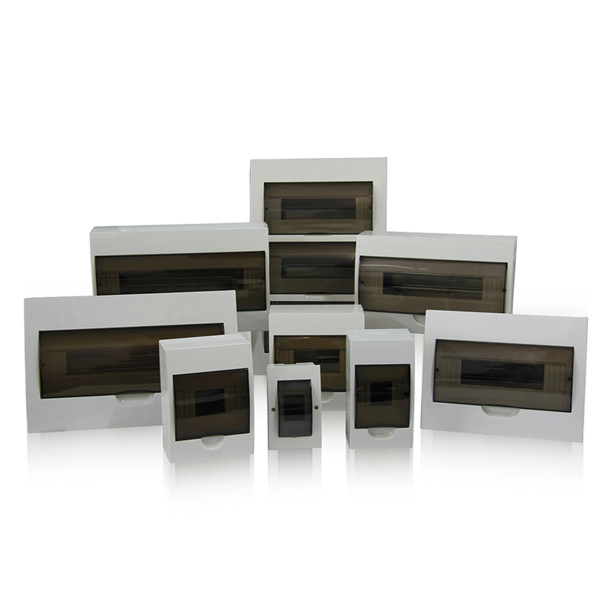
Plastic, metal and metal-base distribution directions support modular equipment installation. Choose surface or flush construction, module count, rows, door style, terminals and cable entry. Review the assembled configuration and destination requirements. An enclosure IP designation is specific to that construction and installation, not a blanket rating for every board.
Enquire about this range ↗Contactors for different loads
The range includes conventional and miniature contactors, modular contactors and capacitor-switching directions. State motor or other load duty, operating voltage, current, coil supply, auxiliary contacts and switching frequency. Capacitor switching needs its own inrush and compensation brief. Select power ratings at the actual voltage and utilization category.
Enquire about this range ↗Motor overload and circuit protection
Thermal overload relays and motor-protection circuit breakers support coordinated motor circuits. Provide motor nameplate data, starting method, full-load current and operating conditions. Select the appropriate adjustment band, trip behaviour, contactor and short-circuit protection rather than assuming a series-wide adjustment range applies to a single device.
Enquire about this range ↗Starters and motor-control assemblies
Direct-on-line, enclosed and star-delta starter directions support different motor-starting arrangements. Soft-starter cabinets are also a project enquiry direction. Submit the motor and supply details, starting duty, control sequence, enclosure and protection requirements. Agree the assembly drawing and bill of materials before comparing complete cabinet quotations.
Enquire about this range ↗Smart circuit protection and switches
Smart breaker, residual-current breaker and switching directions connect local circuit operation with monitoring and remote control. Specify the protection function separately from communication features. Establish which electrical quantities are available, control permissions, alarm behaviour and operation after a network interruption. Connected operation requires the correct gateway and compatible system.
Enquire about this range ↗Gateways and power-management integration
Gateway directions include cellular, Wi-Fi, wired-network and other communication versions. Confirm the regional network, device protocol, compatible circuit count and software arrangement. Define account ownership, data access, remote switching permissions and support. A gateway variant does not automatically include every communication method or every software feature.
Enquire about this range ↗PV combiner and DC protection
Photovoltaic directions include combiner boxes, DC breakers, isolators, surge devices and fuses. Provide array voltage, string currents, input/output count and prospective fault conditions. Request the actual connection arrangement, polarity instructions, monitoring options and enclosure information. AC switchgear ratings must not be substituted for DC ratings.
Enquire about this range ↗Solar generation and charging products
PV modules, solar inverter directions, microinverters and AC vehicle-charging equipment can be included in a renewable-energy enquiry. Select them by the intended system architecture and local connection requirements. Confirm voltage windows, operating power, communication, protection and documentation. A product family does not establish a complete compatible solar or charging system.
Enquire about this range ↗Voltage regulation and conversion
Single- and three-phase stabilizer directions include different orientations and display formats. Adjustable voltage regulators, control transformers, switching power supplies and sine-wave inverter directions broaden the power-conversion range. Define input, output, frequency, load, waveform and duty separately for each item. A stabilizer and an adjustable regulator perform different tasks.
Enquire about this range ↗Meters and electrical measurement
Analogue and digital panel meters, electronic energy meters and current transformers support monitoring and panel design. Specify the quantity measured, input arrangement, CT ratio, panel cut-out and accuracy requirement. Confirm communication, wiring and calibration evidence where needed. Do not assume a monitoring display is approved for revenue billing.
Enquire about this range ↗Operator controls and signalling
Pushbuttons, indicators, control stations, toggle, pedal, micro, limit, rotary and float-switch directions address different control functions. Time relays, power relays and relay sockets complete control-panel enquiries. Provide contact function, actuator, mounting, electrical duty, environmental exposure and label requirements for the selected item.
Enquire about this range ↗Connectors and modular accessories
Industrial plugs and sockets, modular sockets, breaker auxiliaries, busbar-related accessories and distribution-box fittings can be specified with the protection schedule. Confirm pin arrangement, current, voltage, pole configuration, mounting and compatibility. Auxiliary contacts, alarms, undervoltage releases and shunt releases require a matching host device and control supply.
Enquire about this range ↗Project switchgear and control cabinets
Low-voltage distribution cabinets, soft-starter cabinets, street-lighting control boxes and outdoor electrical control boxes are project directions. Submit a single-line diagram, enclosure environment, fault level, control philosophy and installation constraints. Request the assembly-specific documentation, acceptance tests, labelling and service scope before order approval.
Enquire about this range ↗Related wiring and medium-voltage project requests
Cable trunking, H-form terminal blocks, medium-voltage vacuum switching and dropout-fuse requirements can be submitted as separate project briefs. Confirm the current article and supply scope, system ratings, drawings and required evidence before including these items in an order.
Enquire about this range ↗